The Heretics Testify
By Brother Peter Dimond, O.S.B.
Source: vaticancatholic.com
In the foregoing sections, I have traced out the history of the Fr. Feeney controversy in the late 1940’s and 1950’s, which was preceded by an apostasy from the dogma Outside the Church There is No Salvation which began in the 19th century – on the heels of misinterpreted and fallible statements of Pope Pius IX on “invincible ignorance” and the explosion of the false doctrine of “baptism of desire.” I have pointed out that this heresy (of salvation outside the Church/“invincible ignorance” saving those who die as non-Catholics) is now held almost universally by so-called Catholics and “traditionalists.” And this heresy is leading countless souls to Hell. Below the reader will find a few testimonies made by certain enemies of the Faith who readily admit that the new, heretical “understanding” of Outside the Church There is No Salvation that became widespread in the 20th century before Vatican II was contrary to Catholic dogmatic teaching and 2000 years of Catholic Tradition.
A PROTESTANT TESTIFIES
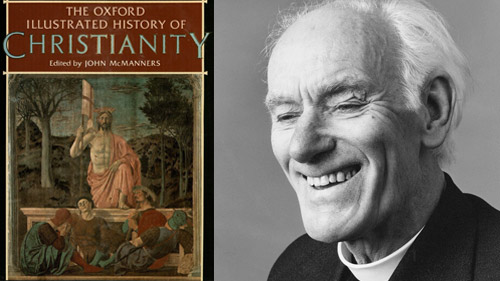
The following quote is from a Protestant author. Please note carefully how this Protestant heretic links the ultimate success of false ecumenism with Pope Pius IX and what he believes to be his teaching that there can be salvation outside the Catholic Church. The Protestant also, of course, praises John XXIII (the initiator of Vatican II) and Paul VI who brought it to completion. Not surprisingly, his ultimate praise goes to the manifest heretic John Paul II, who took the heresies of Vatican II all over the world and exemplified apostasy with many false religions.
John McManners, A Protestant Author, The Oxford Illustrated History of Christianity: “Nevertheless the ecumenical mood had consequences in the European churches. They were far readier to share their altars with each other, and even their church buildings, and to co-operate in common social ventures. This difference was most marked in the Roman Catholic Church. Since the Counter-Reformation Rome taught that it alone was the church... In the nineteenth century, when Catholicism was centralizing itself ever more in Rome, Pope Pius IX admitted that men might be saved outside the church by reason of ‘invincible ignorance’ of the true faith. This was a large concession of charity in the tradition of thought. When the ecumenical movement grew strong, Pope Pius XI formally refused to take part (1928), lest participation imply a recognition that the Roman Catholic Church was but one of a number of denominations. The same encyclical forbade Roman Catholics to take part in conferences with non-Roman Catholics. All this began to change after the Second World War. But it was the ascension of Pope John XXIII in 1958 which began to transform the atmosphere. Part of his object in summoning the Second Vatican Council was to heal the separations in the East and West, and he continued to recognize the Protestants of the West as brothers. An encyclical of 1959 greeted non-Catholics as ‘separated brethren and sons’. In 1960 the pope set up a Secretariat for Christian Unity. In the same year he received Archbishop Fisher of Canterbury. In 1961 he allowed Roman Catholic observers to attend the meeting of the World Council at Delhi. His successor Paul VI carried this new and far more charitable attitude much further. In 1965 he and the Patriarch of Constantinople Athenagoras agreed to a joint declaration deploring the mutual excommunications of 1054 which had stained their past histories as churches. In 1967 he met the Patriarch again, the year after he had met Archbishop Ramsey of Canterbury. The doctrine that Roman Catholics cannot share in worship with other Christians was finally killed by the Polish Pope John Paul II when in 1982 he went to Canterbury Cathedral with the Anglican Archbishop Runcie of Canterbury... All this was part of the coming out of the papacy towards the world.”[1]
Here you have it directly from the Protestant’s mouth. He links the teaching that there is salvation outside the Catholic Church to the future success of the false ecumenical movement (the movement to respect and unite with false religions). This Protestant heretic also commends Pope Pius IX, because he believes that Pope Pius IX introduced the novel heresy of salvation outside the Catholic Church into the minds and souls of Catholics. (Remember, in the section on Pope Pius IX we pointed out how all the modern heretics attempt to use his two fallible statements – which did not teach that non-Catholics can be saved without the Catholic Faith – as the justification for their complete denial of this dogma.) Thus, even the Protestants can see that the allowance of the idea of “invincible ignorance” was “a large concession” (a new idea contrary to Traditional dogma) in the tradition of thought.
A JEW TESTIFIES
The Jewish Week, “Three Faiths and a Glimmer of Hope,” Gary Rosenblatt - Editor and Publisher, 8/29/2003: “During the interactive discussions I came to realize how painful and difficult it has been for the Catholic Church, starting with Vatican II in the early 1960s, to face up to its shameful treatment of the Jews and, as a result, reverse a centuries-old position that salvation for mankind can only come through Jesus.
“…In a lesser-known case, Richard Cardinal Cushing excommunicated a Boston priest, Leonard Feeney, in 1953, for preaching that all non-Catholics would go to Hell. Even though Father Feeney’s words were based on the Gospel, Cardinal Cushing found them offensive, in large part because his sister had married a Jew, said Carroll, and the Cardinal had grown close to the family, sensitizing him to the Jewish perspective toward proselytization.”
Here we see that the Jew, Gary Rosenblatt, acknowledges that the Fr. Feeney controversy concerned whether or not it is necessary to be Catholic to be saved. He explains that Fr. Feeney was “condemned” for teaching (the dogmatic truth) that all who die as non-Catholics will go to Hell. This corroborates the fact that those who opposed Fr. Feeney held that there can be salvation outside the Church, while those who defended Fr. Feeney defended the Catholic dogma Outside the Church There is No Salvation.
A “JESUIT” PRIEST OF THE NEW VATICAN II RELIGION TESTIFIES
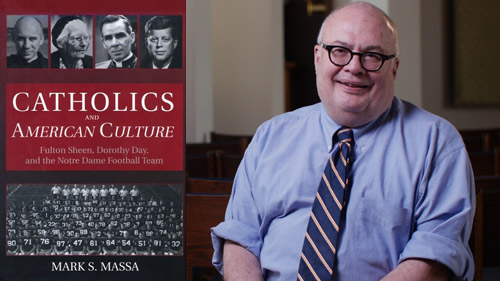
What follows is a quote from a heretical priest who is a member of the Vatican II sect. His name is Fr. Mark Massa, “S.J.” He is a so-called Jesuit of the new Vatican II sect and he admits that the new, heretical understanding of the dogma Outside the Church There is No Salvation, that became widespread starting around 1900, is a new revelation that was not accepted as normal until the twentieth century. Fr. Massa’s testimony is particularly interesting simply because he is a blunt heretic who believes that dogmas can change, so he has no problem giving a fair account of what the Fr. Feeney controversy was about: the denial of the traditional dogma Outside the Church There is No Salvation. The other heretics who deny this dogma are forced into all kinds of crafty explanations, since they claim to believe that dogmas cannot change. But Fr. Massa has no problem admitting what has really occurred with this issue.
Fr. Mark S. Massa, “S.J.”, Catholics and American Culture, p. 21: “‘The first sign of your approaching damnation is that Notre Dame has Protestants on its football team.’ - A Feeneyite at a Notre Dame Football game, 1953 -
“On the afternoon of September 4, 1952, the readers of the Boston Pilot—the voice of the Roman Catholic archdiocese—found on the front page of their usually staid [sober] weekly the text of the trenchant letter from the Holy Office in Rome. The text, dated August 8, addressed a group of Boston Catholics who had kicked up quite a fuss over the ancient theological dictum extra ecclesiam nulla salus (“outside the church there is no salvation”)—a phrase going back to St. Cyprian in the third century and one of the pillars of orthodoxy for Christian believers.
“The letter itself was actually an ambivalent affair… it allowed that a person might be ‘in the church’ by a more than ‘implicit desire’—an interpretation that had achieved almost normative status among Catholic theologians by the mid-twentieth century, although it has never been officially interpreted as such by Rome.”[2]
Fr. Massa is referring here to Protocol 122/49, the letter written against Fr. Feeney in 1949, published in The Pilot, and which I have discussed in detail. Fr. Massa admits that Protocol 122/49 (which is the norm of belief of almost all so-called “traditionalists” today) “was actually an ambivalent affair.” Ambivalent means having two contradictory meanings or notions. And he is quite correct. The letter claimed to affirm Outside the Church There is No Salvation while completely denying it. Fr. Massa further admits that this (heretical) understanding of Outside the Church There is No Salvation as expressed in the Protocol (namely, that non-Catholics can be saved by “invincible ignorance”), had achieved normative status in the minds of “Catholic theologians” in the mid-twentieth century before Vatican II. I continue with his testimony.
Fr. Mark S. Massa, “S.J.”, Catholics and American Culture, p. 27: “Feeney’s message—that the Catholic tradition stood over and against a bankrupt post-Protestant culture teetering on the brink of intellectual anarchy and physical annihilation—reached ready ears. By the late 1940’s the center [Fr. Feeney’s center] boasted two hundred converts…”[3]
Fr. Mark S. Massa, “S.J.”, Catholics and American Culture, pp. 32-33: “On strictly theological grounds, Feeney’s teaching was not as outrageous or pathological as might appear from the vantage of post-Vatican II Catholic reality. Catholic propagandists in Counter-Reformation Europe had certainly believed their Protestant opponents, no less than Moslem infidels, to be beyond the reach of grace [sanctifying grace], and a rigorist interpretation of Cyprian’s phrase clearly uncovers the motives undergirding much of the missionary activity between the sixteenth and twentieth centuries. The urgency of ‘snatching souls’ from the jaws of hell inspired Jesuit Francis Xavier in India… to go out and preach the good news to the ‘people that walked in darkness’ (Isa. 9:2)…
“Long before 1965, however—certainly by the end of the decade following the Second World War—most North American Catholics had ceased to believe that their good Protestant and Jewish neighbors were going to eternal ruin at death, invincibly ignorant or not. Leonard Feeney had recognized as early as 1945 this quiet but quite important revolution in Catholic thinking about boundaries between Catholics and North American culture. Indeed, Feeney’s insight saves the Boston Heresy Case from comic opera and makes it an important episode in the North American experience.”[4]
Fr. Massa is admitting here that most “Catholics” well before Vatican II had ceased believing that there is no salvation outside the Catholic Church (i.e., that those who die as non-Catholics cannot be saved), and that this is why Fr. Feeney met with such resistance in reaffirming this dogmatic truth.
Fr. Mark S. Massa, “S.J.”, Catholics and American Culture, p. 34: “Feeney’s rigorist interpretation of extra ecclesiam nulla salus [outside the Church there is no salvation] arguably stood closer to its meaning held by Pope Innocent III in the thirteenth and St. Francis Xavier in the sixteenth centuries than did that of his ‘liberal’ Catholic opponents who found his teaching abhorrent. Indeed, in the era between the Reformation and Vatican II, ‘the church’ in official dogmatic statements had meant precisely what Feeney said it did…”[5]
Here we see Fr. Massa admitting that “Fr. Feeney’s teaching” was exactly what the Church had stated in official dogmatic pronouncements.
Fr. Mark S. Massa, “S.J.”, Catholics and American Culture, p. 35: “The church found itself in a no win situation, trying to hold on to its claims to unequivocal truth even while censuring one who had proclaimed that truth a little too literally… The boundary line marking those saved from those condemned had moved (or perhaps been moved) to include others (that is, most Americans) who had no desire, implicit or otherwise, to join the Roman communion.”[6]
Fr. Massa admits here that the boundary line of those who could be part of the Church (and therefore could be saved) had been moved; he further admits that the new (heretical) boundary definition (of Protocol 122/49, etc.) included people who had no desire or intention to become Roman Catholics (i.e., non-Catholics).
Fr. Mark S. Massa, “S.J.”, Catholics and American Culture, p. 35: “…Doctrinal positions that had been considered rigorous but nonetheless orthodox at an earlier moment in North American Catholic history were now perceived to be beyond the pale—beliefs that the collective now declared to be deviant and even dangerous to the community. The collective conscience had changed, the boundary between what constituted ‘inside’ and ‘outside’ had moved or been scaled down, and the official interpretation of what it meant to be ‘outside the church’ had changed with it. …”[7]
Fr. Mark S. Massa, “S.J.”, Catholics and American Culture, p. 37: “The Boston Heresy Case foreshadowed a Catholic future that would take the route charted by those whom Feeney termed ‘accommodationist liberals.’ This may seem like a penetrating glimpse of the obvious today, now safely on the other side of Vatican II, but it was not always so obvious. There was a time, before Knute Rockne’s day, when one expected everyone on Notre Dame’s football team to be a good Catholic.”[8]
Fr. Massa concludes his chapter on the Fr. Feeney controversy by admitting that it foreshadowed a new “Catholic future” that was fulfilled after Vatican II. He is thus corroborating our point: that without the denial of this dogma Vatican II could never have occurred.
[1] The Oxford Illustrated History of Christianity, by John McManners, cap. 10, “The Ecumenical Movement,” Oxford, NY: Oxford University Press, 1990, p., 373.
[2] Fr. Mark Massa, Catholics and American Culture, p. 21.
[3] Fr. Mark Massa, Catholics and American Culture, p. 27.
[4] Fr. Mark Massa, Catholics and American Culture, pp. 32-33.
[5] Fr. Mark Massa, Catholics and American Culture, p. 34.
[6] Fr. Mark Massa, Catholics and American Culture, p. 35.
[7] Fr. Mark Massa, Catholics and American Culture, p. 35.
[8] Fr. Mark Massa, Catholics and American Culture, p. 38.