The Vatican II sect on partaking in non-Catholic worship
Source: vaticancatholic.com
Pope Pius XI, Mortalium Animos (# 10), Jan. 6, 1928: “… this Apostolic See has never allowed its subjects to take part in the assemblies of non-Catholics…”[1]
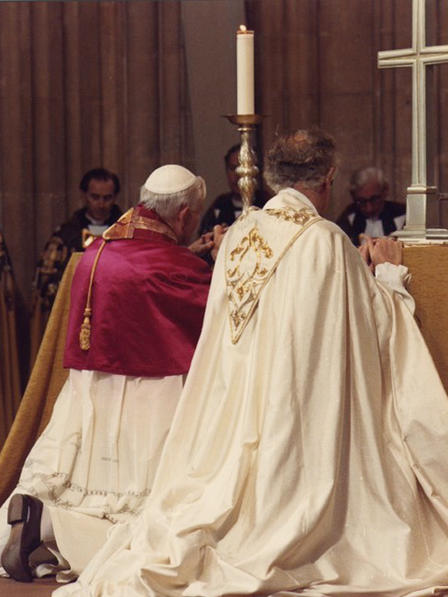
John Paul II in common prayer in 1982, in the Anglican Cathedral, with the schismatic and heretical “Archbishop” of Canterbury (an Anglican), who is just a layman posing as a bishop
We’ve already documented that the Vatican II antipopes repeatedly partake in non-Catholic religious ceremonies. This was condemned by Pope Pius XI. Expressing the universal Tradition of the Church on this matter, he stated:
Pope Pius XI, Mortalium Animos (# 10), Jan. 6, 1928: “… this Apostolic See has never allowed its subjects to take part in the assemblies of non-Catholics…”[2]
All Catholic moral theology manuals before Vatican II reiterated this truth. They taught that it’s a mortal sin against the divine law for Catholics to partake in non-Catholic worship.
Pope Pius IX, Neminem vestrum (# 5), Feb. 2, 1854: “We want you to know that those same monks sent Us a splendid profession of Catholic faith and doctrine… They eloquently acknowledged and freely received the regulations and decrees which the popes and the sacred congregations published or would publish – especially those which prohibit communicatio in divinis (communion in holy matters) with schismatics… They acknowledge that they condemn the error of the schismatic Armenians and recognize that they are outside of the Church of Jesus Christ.”[3]
Notice that the decrees and regulations of the popes prohibit communication in divine things with schismatics.
Pope Pius VI, Charitas (# 31-32), April 13, 1791, speaking of priests who went along with the notoriously heretical civil constitution of the clergy in France: “Above all, avoid and condemn the sacrilegious intruders… do not hold communion with them especially in divine worship.”[4]
Speaking of priests who belong to the “Old Catholic” sect, which publicly rejects Vatican I and its definition on Papal Infallibility, Pope Pius IX declared:
Pope Pius IX, Graves ac diuturnae (# 4), March 23, 1875: “They [the faithful] should totally shun their religious celebrations, their buildings, and their chairs of pestilence which they have with impunity established to transmit the sacred teachings. They should shun their writings and all contact with them. They should not have any dealings or meetings with usurping priests and apostates from the faith who dare to exercise the duties of an ecclesiastical minister without possessing a legitimate mission or any jurisdiction.”[5]
Canon 1258.1, 1917 Code of Canon Law: “It is not licit for the faithful by any manner to assist actively or to have a part in the sacred rites of non-Catholics.”[6]
But the Vatican II sect and its “popes” officially teach just the opposite:
Vatican II document, Unitatis redintegratio (# 15):
“These churches [the schismatic “Orthodox”], though separated from us, yet possess true sacraments… Therefore some worship in common, given suitable circumstances and the approval of church authority, is not merely possible but to be encouraged.”[7]
This is an attempt to overturn the divine law forbidding Catholics to partake in non-Catholic worship. It is heresy. This is why we have repeatedly seen the post-Vatican II antipopes partake in non-Catholic worship and pray with non-Catholics.
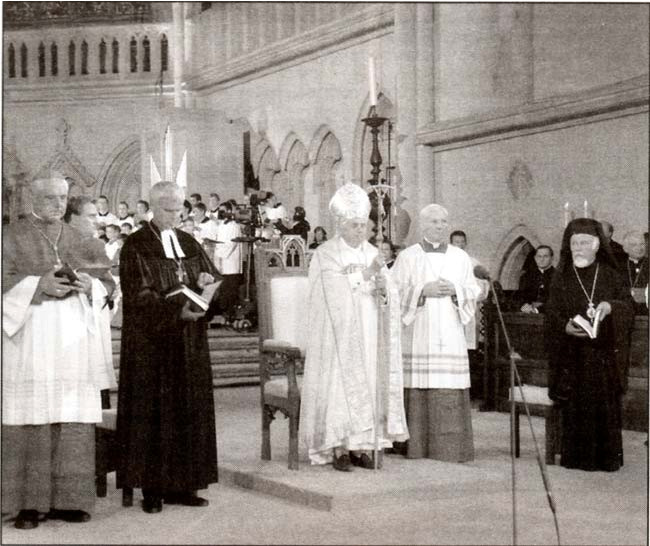
Benedict XVI praying ecumenical Vespers on Sept. 12, 2006.[8] Notice that Benedict XVI explicitly acknowledges that he is worshipping with them.
Benedict XVI, Address during ecumenical Vespers service, Sept. 12, 2006: “Dear Brothers and Sisters in Christ! We are gathered, Orthodox Christians, Catholics and Protestants – and together with us there are also some Jewish friends – to sing together the evening praise of God… This is an hour of gratitude for the fact that we can pray together in this way…”[9]
In this book, we have given and will continue to give many other examples of this activity from the Vatican II antipopes.
The incredible Directory for the Application of the Principles and Norms of Ecumenism
Perhaps the clearest expression of the new religion in regard to participation in non-Catholic worship is the Directory for the Application of the Principles and Norms of Ecumenism, promulgated by John Paul II and the Pontifical Council for Promoting Christian Unity in 1993.
In # 23, it encourages Episcopal Conferences to take "special measures" to avoid the "danger of proselytism" (trying to convert others).[10]
In # 50c, it encourages Catholic religious to organize meetings among Protestants of “various churches… for liturgical prayer, for recollection, and spiritual exercises.”[11]
In # 85, the Directory explains how "it is useful" to encourage exchanges between Catholic monasteries and those of other religions.[12]
In # 118, the Directory says that Catholics who attend non-Catholic churches are "encouraged to take part in the psalms, responses, hymns and common actions of the Church in which they are guests.”[13]
As we can see, #50c and #118 specifically encourage exactly what Pius XI said the Apostolic See has never allowed: participation in non-Catholic worship.
In # 119, it states: "In a Catholic liturgical celebration, ministers of other Churches or ecclesial Communities may have the place and liturgical honors proper to their rank and their role..."[14]
In # 137, it states, "if priests, ministers or communities not in full communion with the Catholic Church do not have a place or the liturgical objects necessary for celebrating worthily their religious ceremonies, the diocesan bishop may allow them the use of a church or a Catholic building and also lend them what may be necessary for their services. Under similar circumstances, permission may be given to them for interment or for the celebration of services at Catholic cemeteries."[15]
In # 158, the Directory says that when mixed marriages take place "the local Ordinary may permit the Catholic priest to invite the minister of the party of the other Church or ecclesial Community to participate in the celebration of the marriage, to read from the Scriptures, give a brief exhortation, and bless the couple."[16]
In # 187, the Directory recommends that Catholics and non-Catholics work together in drawing up texts of common Creeds, psalms, scriptural readings, and hymnbooks to be used when they pray and witness together.[17]
This is a new religion. It is an official program of participation in non-Catholic worship, directly contrary to the divine law which teaches that Catholics are forbidden to partake in non-Catholic worship.
On March 25, 1993, Antipope John Paul II "approved this Directory, confirmed it by his authority and ordered that it be published. Anything to the contrary notwithstanding."[18] John Paul II also approved this incredibly heretical directory on ecumenism in his encyclical Ut Unum Sint:
John Paul II, Ut Unum Sint (# 16), May 25, 1995: “More recently, the Directory for the Application of Principles and Norms of Ecumenism, issued with my approval by the Pontifical Council for Promoting Christian Unity, has applied them to the pastoral sphere.”[19]
So, the question is: How can the Catholic Church now teach and recommend (participation in non-Catholic worship) exactly what the Catholic Church has always forbidden under pain of mortal sin? The answer is that it cannot overturn something that involves the Faith and is connected to the divine law. The answer is that such a new teaching is absolute proof that the Vatican II sect and its antipopes are formally heretical and hold no authority in the Catholic Church.
[1] The Papal Encyclicals, by Claudia Carlen, Raleigh: The Pierian Press, 1990, Vol. 3 (1903-1939), p. 317.
[2] The Papal Encyclicals, Vol. 3 (1903-1939), p. 317.
[3] The Papal Encyclicals, Vol. 1 (1740-1878), p. 321.
[4] The Papal Encyclicals, Vol. 1 (1740-1878), p. 184.
[5] The Papal Encyclicals, Vol. 1 (1740-1878), p. 452
[6] The 1917 Pio-Benedictine Code of Canon Law, translated by Dr. Edward Von Peters, San Francisco, CA: Ignatius Press, 2001, p. 83.
[7] Decrees of the Ecumenical Councils, , Sheed & Ward and Georgetown University Press, 1990, Vol. 2, pp. 915-916.
[8] L’Osservatore Romano, Sept. 20, 2006, p. 10.
[9] L’Osservatore Romano, Sept. 20, 2006, p. 10.
[10] Directory for the Application of the Principles and Norms of Ecumenism, by the Pontifical Council for Promoting Christian Unity, Boston, MA: St. Paul Books & Media, p. 21.
[11] Directory for the Application of the Principles and Norms of Ecumenism, p. 37.
[12] Directory for the Application of the Principles and Norms of Ecumenism, p. 59.
[13] Directory for the Application of the Principles and Norms of Ecumenism, p. 77.
[14] Directory for the Application of the Principles and Norms of Ecumenism, p. 77.
[15] Directory for the Application of the Principles and Norms of Ecumenism, p. 83.
[16] Directory for the Application of the Principles and Norms of Ecumenism, pp. 90-91.
[17] Directory for the Application of the Principles and Norms of Ecumenism, pp. 105-106.
[18] Directory for the Application of the Principles and Norms of Ecumenism, p. 124.
[19] The Encyclicals of John Paul II, Huntington, IN: Our Sunday Visitor Publishing Division, 1996, p. 924.