The Latin Text of the Oldest Surviving Papal Decree Rejects “Baptism of Desire” - Pope St. Siricius
By Brother Peter Dimond, O.S.B.
Source: vaticancatholic.com
THE OLDEST SURVIVING PAPAL DECREE REFUTES ‘BAPTISM OF DESIRE’
In AD 385 Pope St. Siricius issued a decree to Himerius. This document is frequently called a Letter to Himerius. However, it was actually an authoritative decree in which Pope St. Siricius uses his apostolic authority, promulgates laws, and declares that his decree is to be circulated to, and observed by, all the priests and bishops of the Catholic Church. It was therefore an authoritative act of the Holy See. Pope St. Siricius’ decree to Himerius is actually the oldest completely-preserved papal decree in existence. There were papal decrees before Siricius’ time (Siricius makes reference to them), but his decree is the oldest one that has been completely preserved. In the decree, Pope St. Siricius makes striking statements on the necessity of infant baptism and adult baptism. He also explicitly and completely rejects the concept of baptism of desire. An examination of the Latin text demonstrates without any doubt that Pope St. Siricius (and the teaching of the Catholic Church) contradicted the idea of baptism of desire.
The facts below prove, to any honest person, that Siricius’ decree and the early Church rejected the idea of ‘baptism of desire’ (BOD). Nevertheless, there are many extremely dishonest people in the world, including among those who claim to be ‘traditional Catholics’. Sadly, some of them have such an attachment to the concept of ‘baptism of desire’ (and the heresy of salvation outside the Church) that they will flat out deny the existence of any quote or fact that contradicts BOD, no matter how certain its existence or how clear its teaching. They lose all credibility in the process.
In regard to their failure to even acknowledge reality (i.e. the existence of quotes against their position), they deserve to be compared to supporters of homosexuality who claim that the Bible does not condemn homosexual behavior. Yes, there are many people who profess to be ‘Christian’ and actually argue that no applicable passage in Sacred Scripture condemns homosexual behavior. They attempt to explain away every single biblical passage typically cited on the matter. They even defend their view in published works! That’s absurd, you might say. Well, as the facts below demonstrate, to deny that Pope St. Siricius’ decree contradicts the idea of ‘baptism of desire’ is equally absurd.
We invite everyone who wants the truth – e.g. everyone with a fidelity to, and a belief in, Catholic teaching and the authority Christ conferred upon St. Peter and his successors – to carefully consider these facts. We ask them to reflect upon the significance and gravity of this papal decree and related facts in regard to the issue at hand, and submit to the Catholic position dictated by them.
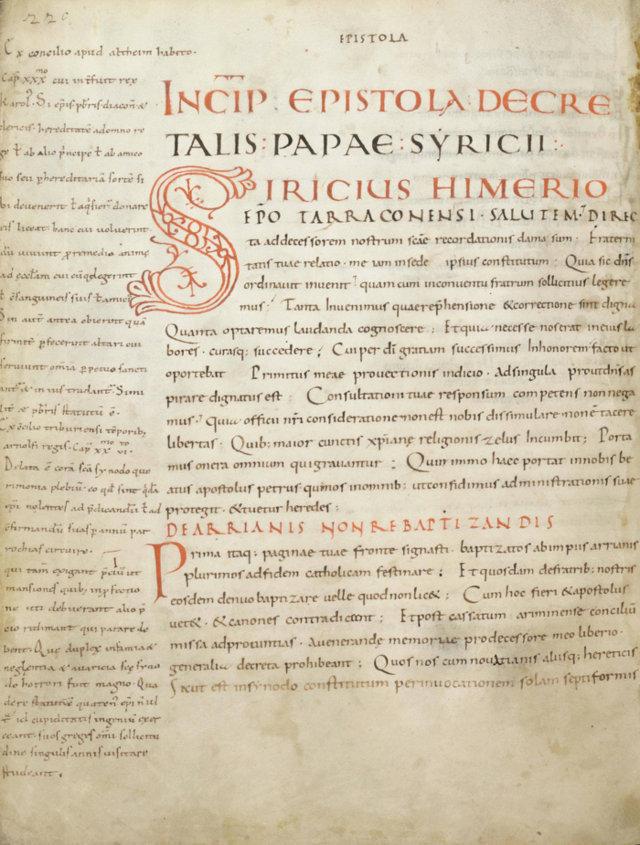
THE KEY PART OF THE DECREE
Here’s what the Pope declares.
Pope St. Siricius, Decree to Himerius, A.D. 385:
LATIN: "Sicut sacram ergo paschalem reverentiam in nullo dicimus esse minuendam, ita infantibus qui necdum loqui poterunt per aetatem vel his, quibus in qualibet necessitate opus fuerit sacra unda baptismatis, omni volumus celeritate succurri, ne ad nostrarum perniciem tendat animarum, si negato desiderantibus fonte salutari exiens unusquisque de saeculo et regnum perdat et vitam.
“Therefore just as we say that the holy paschal observance is in no way to be diminished, we also say that to infants who will not yet be able to speak on account of their age or to those who in any necessity will need the holy stream of baptism, we wish succor to be brought with all celerity, lest it should tend to the perdition of our souls if the saving font be denied to those desiring it and every single one of them exiting this world lose both the Kingdom and life.”
Quicumque etiam discrimen naufragii, hostilitatis incursum, obsidionis ambiguum vel cuiuslibet corporalis aegritudinis desperationem inciderint, et sibi unico credulitatis auxilio poposcerint subveniri, eodem quo poscunt momento temporis expetitae regenerationis praemia consequantur. Hactenus erratum in hac parte sufficiat; nunc praefatam regulam omnes teneant sacerdotes, qui nolunt ab apostolicae petrae, super quam Christus universalem construxit Ecclesiam, soliditate divelli.”
Whoever should fall into the peril of shipwreck, the incursion of an enemy, the uncertainty of a siege or the desperation of any bodily sickness, and should beg to be relieved by the unique help of faith, let them obtain the rewards of the much sought-after regeneration in the same moment of time in which they beg for it. Let the previous error in this matter be enough; [but] now let all priests maintain the aforesaid rule, who do not want to be torn from the solidity of the apostolic rock upon which Christ constructed His universal Church.”
The Pope’s words are quite clear. He completely rejects the idea of ‘baptism of desire.’
He begins by speaking of the discipline to celebrate the baptism of adult converts at Paschal time. Paschal time is when the Resurrection is celebrated. Since Baptism is the rising from the state of condemnation to new life in Christ (see Colossians 2:12; Romans 6:3-4; etc.), it became customary to celebrate the baptism of adult converts at Paschal time, after the unbaptized catechumens had undergone a period of testing and instruction in preparation for the Christian life. As this decree and others clearly prove, the custom of delaying adult baptisms until Paschal time was not incompatible with the position – and the Church’s infallible teaching – that all those preparing for Baptism would indeed be lost if they died before receiving it. No one can be saved without Baptism, as Jesus declared in John 3:5 and the Church infallibly teaches. God can and will keep good-willed and sincere souls alive until Baptism. He is in control.
The practice of baptizing adult converts at Paschal time (and the custom of an extended catechumenate) was a disciplinary one. It was not a requirement of Apostolic Tradition, as we see in Acts chapter 8. There we read that Philip baptized the Eunuch of Candace after a very brief discussion of the basics of the Christian faith. So, while declaring that the holy Paschal observance is to be continued, Siricius adds that if these unbaptized catechumens find themselves in any necessity at all, they are to be baptized with all celerity - that is, with all swiftness or right away. He then explains why he’s insistent on this point. He declares that they must be baptized right away in any kind of necessity, “lest it should tend to the perdition of our souls if the saving font be denied to those desiring it and every single one of them exiting this world lose both the Kingdom and life.” Obviously, that completely contradicts the concept of ‘baptism of desire.’ The Pope teaches that all those who desire water baptism, but die without receiving it, will not be saved.
TAKING A CLOSER LOOK AT THE LATIN TEXT
To further demonstrate that Pope St. Siricius’ decree rejects baptism of desire, let’s take a closer look at his words.
Pope St. Siricius, Decree to Himerius, A.D. 385:
LATIN: "Sicut sacram ergo paschalem reverentiam in nullo dicimus esse minuendam, ita infantibus qui necdum loqui poterunt per aetatem vel his, quibus in qualibet necessitate opus fuerit sacra unda baptismatis, omni volumus celeritate succurri, ne ad nostrarum perniciem tendat animarum, si negato desiderantibus fonte salutari exiens unusquisque de saeculo et regnum perdat et vitam.
“Therefore just as we say that the holy paschal observance is in no way to be diminished, we also say that to infants who will not yet be able to speak on account of their age or to those who in any necessity will need the holy stream of baptism, we wish succor to be brought with all celerity, lest it should tend to the perdition of our souls if the saving font be denied to those desiring it and every single one of them exiting this world lose both the Kingdom and life.”
Quicumque etiam discrimen naufragii, hostilitatis incursum, obsidionis ambiguum vel cuiuslibet corporalis aegritudinis desperationem inciderint, et sibi unico credulitatis auxilio poposcerint subveniri, eodem quo poscunt momento temporis expetitae regenerationis praemia consequantur. Hactenus erratum in hac parte sufficiat; nunc praefatam regulam omnes teneant sacerdotes, qui nolunt ab apostolicae petrae, super quam Christus universalem construxit Ecclesiam, soliditate divelli.”
Whoever should fall into the peril of shipwreck, the incursion of an enemy, the uncertainty of a siege or the desperation of any bodily sickness, and should beg to be relieved by the unique help of faith, let them obtain the rewards of the much sought-after regeneration in the same moment of time in which they beg for it. Let the previous error in this matter be enough; [but] now let all priests maintain the aforesaid rule, who do not want to be torn from the solidity of the apostolic rock upon which Christ constructed His universal Church.”
In the Latin of the decree we find the word “desiderantibus”. That’s the plural present participle in the dative case of the verb desidero (I desire or want). Here, desiderantibus literally means: “to those desiring”. The decree thus speaks directly about unbaptized catechumens desiring water baptism. In that sentence we also find “negato… fonte salutari”. That’s an ablative absolute – that is, a clause generally consisting of a noun and a modifying participle in the ablative case. Here the noun is “fonte,” from fons, meaning: a fountain; a spring; a font. “Fonte” refers to the font of baptism. “Salutari” (which means saving) is fonte’s accompanying adjective in this sentence. “Fonte salutari” means: “with the saving font”. “Negato” is a perfect passive participle. It’s from the verb nego: I deny or refuse. Here “negato,” a perfect passive participle in the ablative case, means “having been denied”. So, “negato… fonte salutari,” the ablative absolute, literally means: “with the saving font having been denied”; or, it could be translated into more flowing English as: “if the saving font be denied”. Denied to whom? The pope says, “desiderantibus,” to those desiring it.
So, the decree deals directly with cases in which the Sacrament of Baptism is being withheld from, or denied to, those who desire it (those who want it). In fact, in these paragraphs the Pope uses numerous verbs to describe the situation in which people would ask for or even beg for baptism (e.g. poposcerint; expetitae). Yet they are all lost, he teaches, if they don’t get it.
The fact is that if someone is of good will, God will keep that person alive until Baptism.
St. Augustine, Against Julian, Book 5, Chap. 4: “Of the number of the elect and predestined, even those who have led the very worst kind of life are led to repentance through the goodness of God… Not one of them perishes, regardless of his age at death; never be it said that a man predestined to life would be permitted to end his life without the sacrament of the Mediator [Baptism]. Because of these men, our Lord says: ‘This is the will of him who sent me, the Father, that I should lose nothing of what He has given me.’”
He is a good, all-powerful, and just God. But the Pope’s decree, and the Church’s teaching, make it clear that no one is saved without water baptism, even those who desire it.
Moreover, I find it particularly interesting that the decree happens to use desiderantibus – a participle form of desidero. As an etymology will show, desidero is the verb from which we get the English verb ‘desire’. There are numerous Latin verbs that could be used to convey the concept of how one intends, wants or desires something. In fact, Siricius uses a number of them in addition to desidero (i.e. poposcerint; expetitae). Yet, desidero most precisely matches our English verb ‘desire’. If we understand ‘baptism of desire’ as ‘baptism by desiring’, one can see the precise connection between the Pope’s reference to desiderantibus and the concept of ‘baptism of desire’ - a concept his decree directly rejects.
In other words, it's not just a coincidence that Siricius’ decree uses a participle of desidero. God made sure the decree would employ a word that precisely matches our English verb ‘desire’ so that the idea of ‘baptism of desire’ would be directly rejected in the oldest surviving papal decree. (On this point, see the section below concerning the significance of this decree for the final days.)
SIRICIUS’ DECREE OF COURSE PROVES THAT THE EARLY CHURCH REJECTED ‘BAPTISM OF DESIRE’
Siricius was a father of the Church. He was a saint, and (most importantly for this particular point) he was a pope. He had the authority of St. Peter and his legitimate successors. His decree proves, without any question, that the early Church rejected the idea of baptism of desire. Even though the meaning of his decree is quite clear, some obstinate proponents of baptism of desire are so dishonest that they will actually claim that his decree does not contradict baptism of desire. Many of them even have the audacity to claim that no father, saint or pope rejected the idea of baptism of desire. That is of course nonsense and a total lie. It is demolished by the facts. Siricius’ decree by itself – and there are many other points we could bring forward – proves that the early Church rejected baptism of desire. Siricius would never have taught and stated what he did if ‘baptism of desire’ had been the belief and teaching of the Church. The outrageous dishonesty and misrepresentation routinely displayed by obstinate proponents of ‘baptism of desire’ is outrageous and mind-boggling.
THE POPE EVEN MENTIONS ACCIDENTS, UNEXPECTED EVENTS, ETC. – THE VERY CIRCUMSTANCES IN WHICH PEOPLE CLAIM A ‘BAPTISM OF DESIRE’ WOULD MOST PARTICULARLY APPLY – AND HE DENIES THE IDEA OF BAPTISM OF DESIRE IN THAT VERY CONTEXT
In these passages the Pope also speaks of how such people, who desire water baptism, might be in the peril of a shipwreck, an enemy incursion, an illness or something similar. It could be a sudden or unexpected event that comes upon them. He refers to various necessities and any kind of bodily sickness.
“Quicumque etiam discrimen naufragii, hostilitatis incursum, obsidionis ambiguum vel cuiuslibet corporalis aegritudinis desperationem inciderint…”
“Whoever should fall into the peril of shipwreck, the incursion of an enemy, the uncertainty of a siege or the desperation of any bodily sickness…”
Yet, what does he say about the fate of people in such circumstances, who desire Baptism but die without having received it? He teaches that all of them lose the Kingdom and life if they exit this world without water baptism.
“… si negato desiderantibus fonte salutari exiens unusquisque de saeculo et regnum perdat et vitam.”
“… if the saving font be denied to those desiring it and every single one of them exiting this world lose both the Kingdom and life.”
He uses the word “unusquisque”, which means “each one of them” or "every single one of them”, stressing the fact that there are no exceptions in this matter. If you cannot see that this completely and totally rejects baptism of desire, well, then, you’re just a liar. It’s also a decree from an early Church pope and saint, in which he invokes his supreme authority and applies his decree to the universal Church.
SIRICIUS ALSO DECLARES THAT WATER BAPTISM IS THE “UNICO CREDULITATIS AUXILIO” (THE UNIQUE HELP OF FAITH): THE ONLY WAY TO BE SAVED
In the next paragraph, the Pope emphasizes that water baptism is their only help, their only way to be saved, whether they are infants or people who desire Baptism and find themselves in danger, in accidents, etc.
“Quicumque etiam discrimen naufragii, hostilitatis incursum, obsidionis ambiguum vel cuiuslibet corporalis aegritudinis desperationem inciderint, et sibi unico credulitatis auxilio poposcerint subveniri, eodem quo poscunt momento temporis expetitae regenerationis praemia consequantur. Hactenus erratum in hac parte sufficiat; nunc praefatam regulam omnes teneant sacerdotes, qui nolunt ab apostolicae petrae, super quam Christus universalem construxit Ecclesiam, soliditate divelli.”
“Whoever should fall into the peril of shipwreck, the incursion of an enemy, the uncertainty of a siege or the desperation of any bodily sickness, and should beg to be relieved by the unique help of faith, let them obtain the rewards of the much sought-after regeneration in the same moment of time in which they beg for it. Let the previous error in this matter be enough; [but] now let all priests maintain the aforesaid rule, who do not want to be torn from the solidity of the apostolic rock upon which Christ constructed His universal Church.”
He refers to water baptism as the “unico credulitatis auxilio,” that is, “the unique help of faith or belief”. Credulitatis, meaning of faith or of belief, is the genitive form of credulitas (faith or belief). According to the pope’s teaching, receiving the Sacrament of Baptism is the unique help of faith. Receiving it is the first condition, and the only way, to be saved through the faith, as Scripture also teaches.
“… having been buried with him in baptism, by which you were also raised with him through the faith [διὰ τῆς πίστεως]…” – Colossians 2:12
“For in Christ Jesus you are all sons of God, through the faith [διὰ τῆς πίστεως]. For as many of you as were baptized into Christ have put on Christ.” – Galatians 3:26-27
There is no such thing as a belief or faith (a credulitas) that can bring a person to salvation without water baptism. It is the only way that one receives the true, saving faith. That’s why the Church has also taught that only those who have received the Sacrament of Baptism are part of the faithful. The words “unico auxilio” are in the ablative case. They are an ablative of means connected with “subveniri”, which here means: “to be relieved”. Siricius says that those in any necessity who beg for the Sacrament of Baptism are to be relieved “unico auxilio,” by the unique help “credulitatis” (of belief). Receiving the Sacrament of Baptism is the only way for them to be saved.
THE UNIQUE HELP EXCLUDES OTHER WAYS OF SALVATION AND OTHER SO-CALLED “BAPTISMS”
“Unico,” which is a form of “unicus,” means: “unique; one-and-only; peerless; unparalleled”. There can be no alternatives, no other kinds of baptism. Receiving water baptism is the only way to be saved – for infants, for those who desire it, for those who are in any kind of predicament, necessity, accident, illness, etc. That’s the teaching of Pope St. Siricius. That’s the teaching of the Catholic Church. That’s what we find in every single infallible and dogmatic decree to the universal Church on the issue, even though God allowed errors to be taught on this matter in fallible sources and by fallible men.
Pope Clement V, The Council of Vienne, 1311-1312: “Besides, only one baptism regenerating all who are baptized in Christ must be faithfully confessed by all just as ‘one God and one faith’ [Eph. 4:5], which celebrated in water in the name of the Father and of the Son and of the Holy Spirit we believe to be the perfect remedy for salvation for both adults and children.”
Pope Paul III, The Council of Trent, Can. 5 on the Sacrament of Baptism, Sess. 7, 1547: “If anyone says that baptism [the sacrament] is optional, that is, not necessary for salvation: let him be anathema.”
Pope Paul III, The Council of Trent, Can. 2 on the Sacrament of Baptism, Sess. 7, 1547, ex cathedra: “If anyone should say that real and natural water is not necessary for baptism, and on that account should distort those words of Our Lord Jesus Christ: ‘Unless a man be born again of water and the Holy Spirit’ [John 3:5], into some metaphor: let him be anathema.”
SIRICIUS’ DECREE ALSO SERVES TO COMPLETELY REFUTE THE OBJECTIONS FREQUENTLY ADVANCED BY SUPPORTERS OF ‘BAPTISM OF DESIRE’ FROM 1) THE CATECHISM OF TRENT, 2) THE 1917 CODE OF CANON LAW, AND 3) THEIR FALSE CLAIMS ABOUT THE ORDINARY AND UNIVERSAL MAGISTERIUM
In addition to numerous other facts, Pope St. Siricius’ decree, which has clearly been left by divine providence for our day (see below), provides a powerful refutation of three of the main objections advanced by supporters of ‘baptism of desire’. Those objections are from the Catechism of Trent, the 1917 Code of Canon Law, and their false claims about what the Ordinary and Universal Magisterium teaches. Of course, those arguments have been refuted before. However, Siricius’ decree further devastates them because its content pertains specifically to principles at the heart of those objections.
In short, Siricius’ decree (which directly contradicts ‘baptism of desire’, as we’ve shown) trumps both the authority of the Catechism of Trent and the 1917 Code of Canon Law. It also proves that the Ordinary and Universal Magisterium teaches exactly the opposite of ‘baptism of desire’, while declaring that water baptism is the only way to be saved! It proves that we have the truth (and the teaching of the Catholic Church) on this matter and supporters of BOD don’t. Let's briefly consider the decree’s relevance to each of the three objections.
THE CATECHISM OF TRENT
One of the numerous points made in the updated section concerns the vital distinction on this matter: i.e. that the paragraph of the Catechism of Trent, which is frequently brought forward by supporters of ‘baptism of desire,’ is actually not part of the official teaching that the Catechism of Trent identified as the body of doctrine to be communicated by pastors to the faithful. This point is crucial and has been overlooked by “baptism of desire” supporters. As the aforementioned article proves by a careful examination of the issue and with many quotes, ONLY CERTAIN POINTS OF DOCTRINE are specified by the Catechism of Trent as points of doctrine that can, must or should be communicated by pastors to the faithful. Not everything in the Catechism’s approximately 500 pages was identified as part of the body of doctrine to be passed along to the faithful.
Here are just a few quotes which prove that not everything in the Catechism of Trent was part of the body of doctrine that can, must or should be communicated to the faithful. I could give dozens of other examples.
Catechism of Trent, “Suffered under Pontius Pilate”: “Furthermore, the pastor should not omit the historical part of this Article, which has been so carefully set forth by the holy Evangelists…”
Here we see the Catechism informing the pastor that he should not omit this particular point. That’s because within the vast amount of information in the Catechism, there are things in the Catechism that the pastor could omit. Not every line or paragraph in the Catechism is to be communicated to the faithful.
Catechism of Trent, on Taking God’s name in vain: “The above observation should strongly convince the pastor that on this point it is not enough to speak in general terms…”
Here the Catechism is confirming that there are certain things that must be said to the faithful. Certain things cannot be passed over. But not everything in the Catechism necessarily falls into that category. The sentence above would of course make no sense if everything in the Catechism were automatically intended for the faithful or to be given to the faithful.
Catechism of Trent, on “Life Everlasting”: “The faithful, therefore, are to be informed that the words, life everlasting, signify not only continuance of existence…”
Here again it’s identifying a point that is to be communicated to the faithful, but not everything in the Catechism falls into that category.
Catechism of Trent, Opening Words of the Lord’s Prayer, on Angels: “The pastor need do no more than depict the Angel lighting up the darkness of the prison, touching Peter’s side and awakening him from his sleep.”
Here again we see that not everything in the Catechism needs to be passed along to the faithful.
MORE PROOF THAT ONLY CERTAIN THINGS IN THE CATECHISM WERE SPECIFIED AS POINTS TO BE TAUGHT TO THE FAITHFUL; OTHER THINGS CAN BE OMITTED
Catechism of Trent, on the Eucharist: “It must be taught, then, that to priests alone has been given power to consecrate and administer to the faithful, the Holy Eucharist.”
Catechism of Trent, “Deliver us from Evil”: “It cannot be necessary to remind the faithful of the numerous evils and calamities to which we are exposed…”
Catechism of Trent, “on the forgiveness of sins”: “On this point of doctrine, then, it is the duty of the pastor to teach that, not only is forgiveness of sins to be found in the Catholic Church…”
Catechism of Trent, on Indissolubility: “The pastor should not here omit the salutary admonition of St. Augustine…”
Catechism of Trent, on the Creed, “Almighty”: “The pastor should point out the propriety and wisdom of having omitted all other names of God in the Creed, and of having proposed to us only that of Almighty as the object of our belief.”
Catechism of Trent, on the Effects of the Eucharist: “As, however, no language can convey an adequate idea of its utility and fruits, pastors must be content to treat of one or two points…”
This clearly shows that only certain things in the Catechism will be passed along to the faithful.
Catechism of Trent, Article II: “Wherefore, the pastor should not omit to remind the faithful that the guilt and punishment of original sin were not confined to Adam…”
Catechism of Trent, On the Creed, “On the Trinity”: “… let the pastor teach that the terms nature and person used to express this mystery should be most scrupulously retained; and let the faithful know that unity belongs to essence, and distinction to persons.”
Catechism of Trent, “Thy Will Be Done”: “Though the faithful are not to be left in ignorance of the import of this Petition, yet in this connection many questions concerning the will of God may be passed over which are discussed at great length and with much utility by scholastic doctors.”
The facts above establish without any doubt that within the Catechism of Trent’s 500-plus pages of information, only certain points of doctrine are identified by the Catechism as part of the body of doctrine that can, must or should be communicated to the faithful. That’s how the Catechism is written and set up. Many other examples could be given to further prove the point. The Catechism is telling the pastors that you need to tell them this; you must not forget that; you should not omit this; but it’s not necessary to say this; etc. It makes these statements throughout the entire Catechism because not everything in the Catechism is for the faithful. It’s information given to the parish priest. Only certain portions of that information are identified as what must or should be inculcated by the pastors.
The paragraph of the Catechism frequently cited by supporters of BOD is not one of those points that is identified as a doctrine to be passed along to the faithful. But guess what is? The repeated teaching that no one can be saved without the Sacrament of Baptism and that the entire Church has taught this truth! Here are just a few quotes to prove the point:
Catechism of the Council of Trent, “Matter of Baptism – Fitness,” p. 165: “Upon this subject pastors can teach in the first place that water, which is always at hand and within the reach of all, was the fittest matter of a Sacrament which is necessary to all for salvation.”
According to the Catechism, what is to be communicated to the faithful by pastors is that the Sacrament of Baptism is necessary to all for salvation. It even emphasizes that no one can be saved without water baptism by stating: “water, which is always at hand and within the reach of all”. That contradicts “baptism of desire.” “Baptism of desire” is not a sacrament, as its supporters admit.
Catechism of the Council of Trent, “On Baptism – Necessity of Baptism,” pp. 176-177: “If the knowledge of what has been hitherto explained be, as it is, of highest importance to the faithful, it is no less important to them to learn that THE LAW OF BAPTISM, AS ESTABLISHED BY OUR LORD, EXTENDS TO ALL, so that unless they are regenerated to God through the grace of Baptism, be their parents Christians or infidels, they are born to eternal misery and destruction. Pastors, therefore, should often explain these words of the Gospel: Unless a man be born again of water and the Holy Ghost, he cannot enter into the kingdom of God (Jn. 3:5).”
Notice the references to “it is no less important to them to learn”, and “Pastors, therefore, should…” Again, we see that this is the doctrine pastors are to teach. ‘Baptism of desire’ is not, as the article proves.
Catechism of the Council of Trent, “Baptism made obligatory after Christ’s Resurrection,” p. 171: “Holy writers are unanimous in saying that after the Resurrection of our Lord, when He gave His Apostles the command to go and teach all nations: baptizing them in the name of the Father, and of the Son, and of the Holy Ghost, the law of Baptism became obligatory on all who were to be saved… Hence we can have no doubt that the words of the Savior: Unless a man be born again of water and the Holy Ghost, he cannot enter into the kingdom of God, refer also to the same time which was to follow after His Passion. If, then, pastors explain these truths accurately, there can be no doubt that the faithful will recognize the high dignity of this Sacrament.”
Here the Catechism states that holy writers are unanimous in teaching that after the Resurrection, the law of Baptism became obligatory on all; and that, after that time, no one can enter Heaven without being born again of water and the Spirit, as Jesus taught in John 3:5. That completely refutes the argument supporters of “baptism of desire” base on the alleged authority of a consensus among theologians; for it declares that all theologians (even those who did not remain consistent with themselves on this issue) articulated a position which contradicts “baptism of desire”: i.e., that no one can enter Heaven without water baptism, based on John 3:5. That is the position Catholic writers have unanimously taught. According to the Catechism, the doctrine to be communicated by pastors to the faithful is the position that after the Resurrection, no one enters Heaven without rebirth of water and the Holy Ghost. It is absolutely true that the official teaching of the Catechism of Trent, to be communicated to the faithful, is not “baptism of desire” but contrary to it.
This fact/distinction refutes the major premise of the argument people make from the Catechism of Trent, namely, that ‘baptism of desire’ is part of the official teaching of the Catechism to be passed along by pastors. It is not.
Siricius’ decree, however, provides an addition blow to the Catechism of Trent argument. That’s because, while being more authoritative than the Catechism, Siricius’ decree actually addresses the very same issue that’s mentioned in the non-authoritative paragraph of the Catechism: the “delay” in baptizing adult converts. As we’ve seen, in an authoritative decree binding on all the churches and priests, Siricius mentions the delay in baptizing adult converts and teaches that even if those adult catechumens who desire Baptism died before receiving it, they are all lost. The official teaching of the Catholic Church, therefore, directly rejects ‘baptism of desire’ in the context of discussing the very issue addressed in the Catechism of Trent’s fallible and flawed paragraph!
Pope St. Siricius’ decree proves that the Catechism of Trent’s explanation for the delay in baptizing adult converts is simply wrong. The Catechism’s paragraph on that point was not part of the official teaching the Catechism says is to be communicated to the faithful. Siricius’ decree on this matter is more authoritative, and its essential teaching was even repeated in numerous papal quotes (see below). The decree of Siricius, among the many other important facts in our updated section on the Catechism of Trent, serves to devastate the argument advanced by supporters of ‘baptism of desire’ from the Catechism of Trent.
SIRICIUS’ DECREE ALSO REFUTES THE OBJECTION FROM THE 1917 CODE OF CANON LAW
As covered in our material, the 1917 Code of Canon Law was a disciplinary act for the Latin Church, not the universal Church. Canon 1 of the 1917 Code of Canon Law disclaims (rejects) a universal applicability. As a result, the Code lacks the infallibility promised for universally binding teachings and laws of the Catholic Church. The Church is infallible in its “teachings and laws imposed upon all” (Pius XII, Mystici Corporis).
Pope Pius XII, Mystici Corporis Christi (# 66), June 29, 1943: “Certainly the loving Mother is spotless in the Sacraments, by which she gives birth to and nourishes her children; in the faith which she has always preserved inviolate; in her sacred laws imposed upon all; in the evangelical counsels which she recommends; in those heavenly gifts and extraordinary graces through which, with inexhaustible fecundity, she generates hosts of martyrs, virgins, and confessors.”
That has been discussed before. It’s also interesting that a prominent supporter of ‘baptism of desire’ admitted that not every canon of the 1917 Code enjoys infallibility.
However, whatever a supporter of ‘baptism of desire’ tries to say about the 1917 Code, Siricius’ decree trumps it. For Siricius declares that “all priests should maintain” (omnes teneant sacerdotes) his rule, “who do not want to be torn from the solidity of the apostolic rock upon which Christ constructed His universal Church” (qui nolunt ab apostolicae petrae, super quam Christus universalem construxit Ecclesiam, soliditate divelli). In fact, he makes this declaration in the very paragraph that rejects ‘baptism of desire’!
Pope St. Siricius also declared that his decree applies to all the bishops: “So that you may get these things which We have written back to your inquiries brought to the notice of all Our fellow bishops” (Ut haec quae ad tua consulta rescripsimus, in omnium coepiscoporum nostrorum perferri facias notionem). His decree is the highest and most authoritative decree a pope can issue on a matter of Church law.
At the very least, every supporter of ‘baptism of desire’ would have to concede that Siricius’ decree cancels out the 1917 Code of Canon Law argument for ‘baptism of desire’. If the 1917 Code of Canon Law proved anything for the doctrinal concept of ‘baptism of desire’, as they claim (and it doesn’t), then Siricius’ decree would prove equally as much against the idea. But Siricius’ decree is actually more authoritative. While purely disciplinary law can be changed, Siricius’ decree trumps the 1917 Code of Canon Law on the doctrinal matter under discussion for numerous reasons.
First, the Pope declares, in specific form, that his decree (which contains the doctrinal statement contradicting ‘baptism of desire’) is to be observed by all the priests and bishops under pain of separation from the Church, while the 1917 Code specifically disclaims a universally binding applicability. Second, the universally binding nature of Siricius’ decree is even found in the very paragraph that rejects ‘baptism of desire’. Third, as will be shown below, the doctrinal truth and principle at the heart of Siricius’ decree, which declares that receiving water baptism is the only way for unbaptized catechumens in danger, etc. to be saved, was repeated in numerous papal statements after Siricius. It was, therefore, the consistent teaching of the Apostolic See on this matter. The Church officially and repeatedly taught that water baptism is the ONLY WAY for anyone to be saved. That truth cannot be rejected without rejecting the faith of the Church.
SIRICIUS’ DECREE PROVES THAT THE ORDINARY AND UNIVERSAL MAGISTERIUM ALSO CONTRADICTS ‘BAPTISM OF DESIRE’ AND PROVES OUR POSITION
Siricius’ decree also demonstrates an important point about the teaching of the Ordinary and Universal Magisterium. The Extraordinary Magisterium, which is exercised, for example, in the dogmatic decrees of universal councils, has declared that no one can be saved without receiving the Sacrament of Baptism. It has declared John 3:5 is to be understood “as it is written”; that there’s only one baptism of water; that only the faithful [the water baptized] are part of the Church; that only the water baptized are subject to the Church; that man must be regenerated to be justified (which contradicts ‘baptism of desire’); that sanctification and the application of Christ’s blood to a soul are inseparable from water baptism; etc. The teaching of the Extraordinary Magisterium certainly refutes the idea of ‘baptism of desire’. (See, for example, the bullet points in the Appendix of this article.) The Ordinary and Universal Magisterium, also being infallible, cannot of course contradict the Extraordinary Magisterium.
Pope St. Siricius’ decree proves that the Ordinary and Universal Magisterium also rejected baptism of desire and affirmed the truth that no one can be saved without the Sacrament of Baptism. That’s because his decree, which rejects baptism of desire, was, by virtue of his order, to be taught to, and repeated by, all the bishops of the Church (omnium coepiscoporum nostrorum). That means that the entire Church and all the bishops in their dioceses, following and implementing his decree, would be teaching the following, namely:
- that “if the saving font be denied to those desiring it”, “every single one of them exiting this world lose both the Kingdom and life”;
- that water baptism is “the unique help of faith”, even for those in “the peril of shipwreck, the incursion of an enemy, the uncertainty of a siege or the desperation of any bodily sickness”;
- that “all priests” must “maintain the aforesaid rule, who do not want to be torn from the solidity of the apostolic rock upon which Christ constructed His universal Church.”
To continue to promote ‘baptism of desire’, in the face of these facts and this decree (among the many others covered in our material), is simply to resist and reject the highest teaching of the Catholic Church. It is to contradict and deny the true faith of the Church.
THE ESSENCE OF SIRICIUS’ DECREE, WHICH CONTRADICTED ‘BAPTISM OF DESIRE’, WAS REPEATED IN NUMEROUS PAPAL STATEMENTS
As alluded to above, it’s important to note that Siricius’ decree on this matter was essentially repeated in numerous statements by Pope St. Leo the Great. The core truth of what Siricius declared against the idea of baptism of desire and any salvation without water baptism, in a law for the universal Church, was the repeated teaching of the popes and the Apostolic See on this matter.
In the following two statements we see that Pope St. Leo the Great repeated, in very similar language, the very same teaching we find in the decree of Pope St. Siricius. He therefore also denied the concept of “baptism of desire”.
Pope St. Leo the Great, Letter 166, Oct. 24, 458, #1: “For at the instance of certain brethren we have discovered that some of the prisoners of war, on their free return to their own homes, such to wit as went into captivity at an age when they could have no sure knowledge of anything, crave the healing waters of baptism, but in the ignorance of infancy cannot remember whether they have received the mystery and rites of baptism, and that therefore in this uncertainty of defective recollection their souls are brought into jeopardy, so long as under a show of caution they are denied a grace, which is withheld, because it is thought to have been bestowed… Consequently the same things, which have come into our mind by the Divine inspiration, have received the assent and confirmation of a large number of the brethren. And so we are bound before all things to take heed lest, while we hold fast to a certain show of caution, we incur a loss of souls who are to be regenerated. For who is so given over to suspicions as to decide that to be true which without any evidence he suspects by mere guesswork? And so wherever the man himself who is anxious for the new birth does not recollect his baptism, and no one can bear witness about him being unaware of his consecration to God, there is no possibility for sin to creep in, seeing that, so far as their knowledge goes, neither the bestower or receiver of the consecration is guilty… And so, whenever such a case occurs, first sift it by careful investigation, and spend a considerable time, unless his last end is near, in inquiring whether there be absolutely no one who by his testimony can assist the other’s ignorance. And when it is established that the man who requires the Sacrament of Baptism is prevented by a mere baseless suspicion, let him come boldly to obtain the grace, of which he is conscious of no trace in himself. Nor need we fear thus to open the door of salvation which has not been shown to have been entered before.”
Notice that in this passage he teaches that people who are to be regenerated (unbaptized catechumens), who even “crave the healing waters of baptism,” will lose their souls if they don’t receive water baptism. There is no ‘baptism of desire.’ Receiving the Sacrament of Baptism is the only way to be saved. That’s the teaching of the Apostolic See. The quote below articulates the same position.
Pope St. Leo the Great, Letter 16, Oct. 21, 447, #6: “Wherefore, as it is quite clear that these two seasons [Easter and Pentecost] of which we have been speaking are the rightful ones for baptizing the chosen in Church, we admonish you, beloved, not to add other days to this observance. Because, although there are other festivals also to which much reverence is due in God’s honor, yet we must rationally guard this principal and greatest sacrament as a deep mystery and not part of the ordinary routine: not, however, prohibiting the license to succor those who are in danger by administering Baptism to them at any time. For while we put off the vows of those who are not pressed by ill health and live in peaceful security to those two closely connected and cognate festivals, we do not at any time refuse this which is the only safeguard of true salvation to anyone in peril of death, in the crisis of a siege, in the distress of persecution, in the terror of shipwreck.”
In this passage, notice his explicit teaching that for unbaptized catechumens in “peril of death,” receiving water baptism is the only way to be saved. It’s “the only safeguard of true salvation”! There is no ‘baptism of desire’. It doesn’t exist. That’s the teaching of the Catholic Church. Also consider how similar his language about “the crisis of a siege... the distress of persecution... the terror of shipwreck” is to Siricius' decree which rejected ‘baptism of desire.’ As the Catholic Church teaches in every single document of faith and morals applicable to the universal Church, the only way for anyone to be saved is to receive water baptism. Those who obstinately deny this are heretics. Those who have the audacity not only to deny this truth, but even to proclaim it heretical or mortally sinful to adhere to this truth (which is the position of almost all 'traditionalist' priests in our day), bring upon themselves even greater damnation.
THE SPECIAL AUTHORITY OF SIRICIUS’ DECREE AND ITS SIGNIFICANCE FOR US NOW IN THE FINAL DAYS
The authority of Pope St. Siricius’ decree needs to be emphasized. As we’ve seen, it was issued to the Catholic Church with the fullness of Siricius’ authority. In it the Pope repeatedly makes reference to his supreme apostolic office and he invokes its authority. He makes it clear that what he declares is binding. He says that his decree is to be sent to, and observed by, all the churches, all the bishops, and all the priests. His decree is the highest and most authoritative decree on matters of Church law that a pope can issue. Embedded within his law and his decree is the teaching that all those desiring water baptism who die without getting it are lost; and that receiving the saving font of water baptism is the only way for people to be saved, whether they are infants, those who desire baptism, or those who are in any necessity whatsoever.
IT’S NOT JUST A COINCIDENCE THAT THE OLDEST SURVIVING PAPAL DECREE IS ONE THAT EXPLICITLY REJECTS THE IDEA OF ‘BAPTISM OF DESIRE’; GOD MADE SURE IT WOULD HAPPEN THAT WAY
It’s not just a coincidence that this particular papal decree, which completely rejects the idea of baptism of desire by using the very verb desidero, and affirms the truth of the absolute necessity of water baptism for salvation by declaring that it’s the only help for those in any danger, happens to be the oldest surviving papal decree in our day. For what characterizes our period, that is, the Great Apostasy and the final days, is the rejection of the necessity of Baptism, as well as the rejection of the necessity of incorporation into Jesus Christ and the Catholic Church for salvation. It’s simply a fact that in our day the false doctrine of baptism of desire is at the heart of that rejection. God arranged it that Pope St. Siricius’ decree, which denies baptism of desire, would be the decree that survives into the final days and stands out in our period as the most ancient.
In His providence, God decided that in the period characterized by the false doctrine of baptism of desire and the denial of the necessity of incorporation into the Church, the most venerable papal decree in all of history, from the standpoint of age, would be one that contains a clear rejection of baptism of desire and an affirmation of the truth of Jesus Christ that no one can be saved without being born again of water and the Spirit in the Sacrament of Baptism (John 3:5).
To put it another way: if someone wanted to discover what the popes and the Papacy, exercising the authority given by Jesus Christ to St. Peter and his successors, historically and authoritatively taught on the necessity of water baptism and the idea of ‘baptism of desire,’ the oldest surviving papal decree in existence would be a good place to start; and in it one finds a clear rejection of the false doctrine of baptism of desire.
By the way, it should be noted that Pope Clement’s famous epistle to the Corinthians was of course earlier than Siricius’ decree. Dated to the first century and approximately the year AD 95, it was a good example of papal primacy and authority in the ancient Church. Other documents are as well. In the epistle to the Corinthians, the Church of Rome (led by Clement) did use its authority to command the Church at Corinth in various ways. That was an example of how the Church of Rome exercised authority over other churches in the very earliest period of Church history. However, Clement’s epistle was not a decretal on points of Church law in the strict sense of the term that later came to be applied to specific types of papal documents. Of those decretal letters, Pope St. Siricius’ decree is the oldest one that has been completely preserved.
JESUS CHRIST IS THE FIRST AND THE LAST: AT THE END, WE CAN LOOK TO THE BEGINNING

Jesus Christ is the Alpha and the Omega (Apocalypse 22:13), the first and the last, the beginning and the end. The faith He revealed does not change. He promised to be with His Church until the consummation of the world (Mt. 28:20). Near the end of the world, when the Church is confronted with multitudes who have abandoned Catholic dogma on the necessity of the Church for salvation, usually with the excuse of ‘baptism of desire,’ we can look to the very beginning: to the earliest papal decree that we have, and we can find in it a specific refutation of the false doctrine of baptism of desire.
As these facts show, the true Church professes only one baptism of water. It profess that John 3:5 is to be understood “as it is written”. It professes that water baptism is the only help to salvation. That’s what the true remnant and the true believers in our day profess. Those who don’t take this position, and get in line with this teaching when presented with these facts, are not part of the true Church. They don’t have the true faith.
APPENDIX- OTHER MAGISTERIAL/DOGMATIC DECREES AND FACTS ON THE CHURCH’S TEACHING ON BAPTISM
- THE CATHOLIC CHURCH PROFESSES ONLY ONE BAPTISM OF WATER (NOT ‘THREE BAPTISMS’)
Pope Clement V, The Council of Vienne, 1311-1312: “Besides, only one baptism regenerating all who are baptized in Christ must be faithfully confessed by all just as ‘one God and one faith’ [Eph. 4:5], which celebrated in water in the name of the Father and of the Son and of the Holy Spirit we believe to be the perfect remedy for salvation for both adults and children.”
Pope Clement V, The Council of Vienne, 1311-1312: “But since one is the universal Church, of regulars and seculars, of prelates and subjects, of exempt and non-exempt, outside of which absolutely (omnino) no one (nullus) is saved (salvatur), one is the Lord, one is the Faith and one is the baptism of all.”
- THE CATHOLIC CHURCH PROFESSES THAT ONE MUST BE BORN AGAIN OF WATER AND THE SPIRIT TO BE SAVED (THAT CONTRADICTS ‘BAPTISM OF DESIRE’)
Pope Eugene IV, The Council of Florence, Exultate Deo, Nov. 22, 1439: “Holy baptism, which is the gateway to the spiritual life, holds the first place among all the sacraments; through it we are made members of Christ and of the body of the Church. And since death entered the universe through the first man, ‘unless we are born again of water and the Spirit, we cannot,’ as the Truth says, ‘enter into the kingdom of heaven’ [John 3:5]. The matter of this sacrament is real and natural water.”
Pope Paul III, The Council of Trent, Can. 5 on the Sacrament of Baptism, Sess. 7, 1547: “If anyone says that baptism [the sacrament] is optional, that is, not necessary for salvation: let him be anathema.”
Pope Paul III, The Council of Trent, Can. 2 on the Sacrament of Baptism, Sess. 7, 1547, ex cathedra: “If anyone should say that real and natural water is not necessary for baptism, and on that account should distort those words of Our Lord Jesus Christ: ‘Unless a man be born again of water and the Holy Spirit’ [John 3:5], into some metaphor: let him be anathema.”
- THE CATHOLIC CHURCH PROFESSES THAT RECEIVING WATER BAPTISM IS THE ONLY WAY TO BE SAVED, INCLUDING FOR ADULTS WHO DESIRE WATER BAPTISM AND ARE IN DANGER, ACCIDENTS, ETC. (THAT CONTRADICTS ‘BAPTISM OF DESIRE’)
Pope St. Siricius, Decree to Himerius, A.D. 385: “Therefore just as we say that the holy paschal observance is in no way to be diminished, we also say that to infants who will not yet be able to speak on account of their age or to those who in any necessity will need the holy stream of baptism, we wish succor to be brought with all celerity, lest it should tend to the perdition of our souls if the saving font be denied to those desiring it and every single one of them exiting this world lose both the Kingdom and life. Whoever should fall into the peril of shipwreck, the incursion of an enemy, the uncertainty of a siege or the desperation of any bodily sickness, and should beg to be relieved by the unique help of faith, let them obtain the rewards of the much sought-after regeneration in the same moment of time in which they beg for it. Let the previous error in this matter be enough; [but] now let all priests maintain the aforesaid rule, who do not want to be torn from the solidity of the apostolic rock upon which Christ constructed His universal Church.”
Pope St. Leo the Great, Letter 16, Oct. 21, 447, #6: “Wherefore, as it is quite clear that these two seasons [Easter and Pentecost] of which we have been speaking are the rightful ones for baptizing the chosen in Church, we admonish you, beloved, not to add other days to this observance. Because, although there are other festivals also to which much reverence is due in God’s honour, yet we must rationally guard this principal and greatest sacrament as a deep mystery and not part of the ordinary routine: not, however, prohibiting the license to succor those who are in danger by administering baptism to them at any time. For while we put off the vows of those who are not pressed by ill health and live in peaceful security to those two closely connected and cognate festivals, we do not at any time refuse this which is the only safeguard of true salvation to anyone in peril of death, in the crisis of a siege, in the distress of persecution, in the terror of shipwreck.”
- THE MAGISTERIAL TEACHING OF ALL PAPAL ENCYCLICALS ON THE ISSUE IS THAT NO ONE IS SAVED, OR IN THE CHURCH OF CHRIST, WITHOUT RECEIVING THE SACRAMENT OF BAPTISM (THAT CONTRADICTS ‘BAPTISM OF DESIRE’)
Pope Pius XI, Quas Primas (#15), Dec. 11, 1925, addressed to the universal Church, concerning entrance into the Kingdom of God: “Which Kingdom indeed is set forth in the Gospels as one into which men prepare to enter by doing penance but are unable to enter except through faith and baptism, which, although it is an external rite, nevertheless signifies and effects an interior regeneration.”
Pope Pius XII Mediator Dei (#47), Nov. 20, 1947, addressed to the universal Church, referring to the Sacrament of Baptism: “… the washing of baptism distinguishes and separates all Christians [christianos omnes] from the rest whom this stream of atonement has not washed and who are not members of Christ…”
Pope Pius XII, Mystici Corporis Christi (# 22), June 29, 1943, addressed to the universal Church: “Actually only those are to be included as members of the Church who have received the laver of regeneration and profess the true faith…”
- THE CHURCH DOGMATICALLY TEACHES THAT ONE CANNOT RECEIVE JUSTIFICATION/SANCTIFICATION WITHOUT WATER BAPTISM (THAT CONTRADICTS ‘BAPTISM OF DESIRE’)
Pope St. Leo the Great, dogmatic letter to Flavian, The Council of Chalcedon, 451: “Let him heed what the blessed apostle Peter preaches, that sanctification by the Spirit is effected by the sprinkling of Christ’s blood (1 Pet. 1:2); and let him not skip over the same apostle’s words, knowing that you have been redeemed from the empty way of life you inherited from your fathers, not with corruptible gold and silver but by the precious blood of Jesus Christ, as of a lamb without stain or spot (1 Pet. 1:18). Nor should he withstand the testimony of blessed John the apostle: and the blood of Jesus, the Son of God, purifies us from every sin (1 Jn. 1:7); and again, This is the victory which conquers the world, our faith. Who is there who conquers the world save one who believes that Jesus is the Son of God? It is He, Jesus Christ, who has come through water and blood, not in water only, but in water and blood. And because the Spirit is truth, it is the Spirit who testifies. For there are three who give testimony – Spirit and water and blood. And the three are one. (1 Jn. 5:4-8) IN OTHER WORDS, THE SPIRIT OF SANCTIFICATION AND THE BLOOD OF REDEMPTION AND THE WATER OF BAPTISM. THESE THREE ARE ONE AND REMAIN INDIVISIBLE. NONE OF THEM IS SEPARABLE FROM ITS LINK WITH THE OTHERS.”
- THE CHURCH DOGMATICALLY TEACHES THAT ONLY THE FAITHFUL ARE SAVED; THAT MAN MUST BE REGENERATED TO BE JUSTIFIED; THAT ONLY THOSE SUBJECT TO THE ROMAN PONTIFF ARE SAVED; AND THAT ONE CANNOT BE PART OF THE FAITHFUL OR SUBJECT TO THE ROMAN PONTIFF WITHOUT WATER BAPTISM. ALL OF THESE FACTS, AMONG OTHERS, REFUTE THE FALSE IDEA OF ‘BAPTISM OF DESIRE’. YOU CAN FIND QUOTES ON THOSE MATTERS IN OUR MATERIAL.